Monday, 24 October 2011

Copyright Case III - Apple vs Samsung Galaxy Tab


“Reuters, which followed the court hearing, notes that the comments
came as part of request by Apple to get an injunction
against Samsung’s tablets in the U.S., and that a formal order on
whether Samsung infringes on an Apple utility patent will be issued
“fairly promptly.”
“We are awaiting the judge’s decision, and Samsung will continue
to actively defend its intellectual proprery rights,” a Samsung
spokesman told CNET.
An Apple spokeswoman reiterated a statement made by the company
earlier this year saying “it’s no coincidence that Samsung’s
latest products look a lot like the iPhone and iPad, from the shape
of the hardware to the user interface and even the packaging.
This kind of blatant copying is wrong, and we need to protect Apple’s
intellectual property when companies steal our ideas.”
The judge’s comments come the same day Apple won an interlocutory
injunction by the Federal Court of Australia against Samsung
and the company’s Galaxy Tab 10.1, keeping the product
from being sold in the country until the case goes to trial. In that
complaint, Apple had argued that the device infringed on two of
its patents relating to multi-touch technologies.” - Lowensohn, J.
(2011)

Analysis
This is very recent case again involving Apple Corp. There is a
tough battle between those two companies Apple and Samsung
and their products. In this copyright infringenment product design
has its key, as Apple claims that Samsung copies product
and packaging designs which I believe is correct. Because of this
Samsung may lose lots of money as this affects selling among
countires.

Copyright Case II - Facebook vs Timeline.com


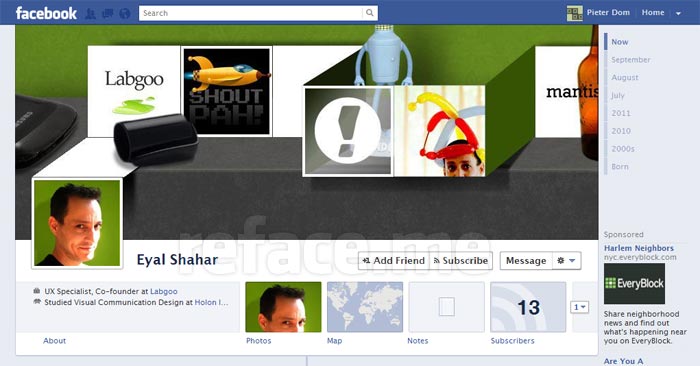
“Facebook has delayed the launch of a controversial new ‘timeline’
feature after a lawsuit was filed against the site by a rival.
Website Timeslines.com sued Facebook a week after the site
announced the new feature, saying it ‘infringes’ its trademarks
and would drive people away from the smaller site.
Facebook founder and CEO Mark Zuckerberg said the new
profile page had been designed so that, ‘you can tell the whole
story of your life on a single page’.
Meanwhile, Timelines.com describes itself as an online location
where people can ‘record, discover and share history. It’s history
recorded by the people, for the people.’
In the lawsuit, filed in Chicago, the site claims that Facebook’s
Timeline feature ‘infringes on Timelines’ federally registered
trademarks in that it causes confusion as to the source of the
services offered to users of the Internet.’
While the court rejected a request from Timelines.com to bar
Facebook from rolling out the feature, the site has delayed rolling
it until October 6. It was meant to have gone live on September
29.” - Bentley, P. (2011)

Analysis
Again similarly to Apples case, trademarking title was the infringement
for Timelines.com. I think Timelines.com were jealous and
they were simply trying to get some money from Facebook by using
quite daft reason. From my point of view it would of been quite
silly for the court to accept this request as Facebook wouldn’t use
their new feature to humiliate Timelines.com. At the end of the
day there is always something that could be potentially infringemental.

Copyright Case I - Apple Inc vs Apple Computers


"It began more than 30 years ago in 1978 when Apple Corps filed
a lawsuit against Apple Computer for trademark infringement.
The legal action was settled in 1981 for a sum that was estimated
to be up to $250million but turned out to be just $80,000.
A condition of the agreement was that Apple Computer would not
enter the music business and Apple Corps would not involve itself
in the computer business. However, in 1986 Apple Corps sued
Apple Computer for violating the agreement after it added audiorecording
capabilities to its computers. A settlement was reached
in 1991 of around $26.5million.
In September 2003, following the launch of Apple iTunes, Apple
Corps sued Apple Computer again for breach of contract.
The case was heard in the High Court in London in 2006 before a
single judge who ruled in favour of the computer company.
On 5 February 2007, Apple Inc. and Apple Corps announced a
settlement of their trademark dispute under which Apple Inc. will
own all of the trademarks related to “Apple” and will license certain
of those trademarks back to Apple Corps for their continued
use. It was reported that Apple Inc paid Apple Corps $500million
to do so.” - Roberts, L. (2010)

Analysis
In this case basically Apple Inc owned by Beatles sued Apple
Corp for the same trademark title. Issue was resolved by court by
differenting music owned by Beatles and computers owned by Apple.
However later on when Apple created iTunes they breached
the contract and case was more serious. Apple Corp decided that
Apple Inc will own all the trademarks and they will license Apple
Corp. This is how The Beatles then were able to launched on iTunes.

Definitions

Copyright

'A copyright is a set of exclusive rights granted by a state to the
creator of an original work or their assignee for a limited period of
time upon disclosure of the work. This includes the right to copy,
distribute and adapt the work. - Wikipedia, Copyright

In simple terms copyright is a protection for creators of their orginal
work. Its an ownership for any work that has been created.
Copyright covers areas in copying, adapting, distributing, communication
with public, renting to public and even performing.
Copyright is not applied by any official registration system.


Patent
'The term patent usually refers to an exclusive right granted to
anyone who invents any new, useful, and non-obvious process,
machine, article of manufacture, or composition of matter, or any
new and useful improvement thereof, and claims that right in a
formal patent application.' - Wikipedia, Patent

This stetement means that patent copyright can be obtained if
an author created an innovation and he/she doesn’t want it to be
reproduced if there isn't license arangement.

Anything can be patented as long as it is new and
hasnt been discovered previously.


Trademark


‘A trademark is a distinctive sign or indicator used by an individual,
business organization, or other legal entity to identify that
the products or services to consumers.
A trademark is typically a name, word, phrase, logo, symbol, design,
image, or a combination of these elements.
The essential function of a trademark is to exclusively identify the
commercial source or origin of products or services, such that a
trademark, properly called, indicates source or serves as a badge
of origin. In other words, trademarks serve to identify a particular
business as the source of goods or services.’ - Wikipedia, Trademark

This statement is self explanotary. Trademark sign is used when
products are involved in trade. Trademark sign however is more
powerfull than copyright that is why trademark sign and copyright
sign are never used togather. In some cases they might, but not
under the same type of product.


Design Right


‘The design right is the appearance of a product, in particular,
the shape, texture, colour, materials used, contours and ornamentation.
To qualify as a new design, the overall impression should
be different from any existing design.
Typically the creator of the design owns any rights in it, except
where the work was commissioned or created during the course
of employment, in which case the rights belong to the employer or
party that commissioned the work.’ - UKCCS, Fact sheet P-15: Designs and design rights
Design right is more about the visual identification that belgongs
strictly to the author. This type of copyright can be aplied only if
the work is orginal.


Copying

'Copying is the duplication of information or an artifact based only
on an instance of that information or artifact, and not using the
process that originally generated it. With analog forms of information,
copying is only possible to a limited degree of accuracy,
which depends on the quality of the equipment used and the skill
of the operator.' - Wikipedia, Copying
There is a very fine line between dupliation of the work/copying
and manipulation of the work that can be used. Based on the
statement above it is also about the quality of the work not always
identicality.
Copying may refer any form of creativity; music, design to text to
softwere.


Crediting


‘In general, the term crediting in the artistic or intellectual sense
refers to an acknowledgement of those who contributed to a work,
whether through ideas or in a more direct sense.
In the creative arts, credits are an acknowledgement of those who
participated in the production. They are often shown at the end of
movies and on CD jackets. In film, video, television, theater, etc.,
credits means the list of actors and behind-the-scenes staff who
contributed to the production.’ - Wikipedia, Credic (creative arts)


There is a very fine line between dupliation of the work/copying
and manipulation of the work that can be used. Based on the
statement above it is also about the quality of the work not always
identicality.
Copying may refer any form of creativity; music, design to text to
softwere.
Well crediting is very simple to understand as it is simply additional
people that contributed to the work/production. They are usually
secondary people not an author.

Overall

Copyright
Submission: Blog (blogger.com), written essay and digital diary
What does blogger got to include?
• Discussions on found cases/interaction
• Examples of cases showing different kinds of property rights
• Definitions of intelectual property rights